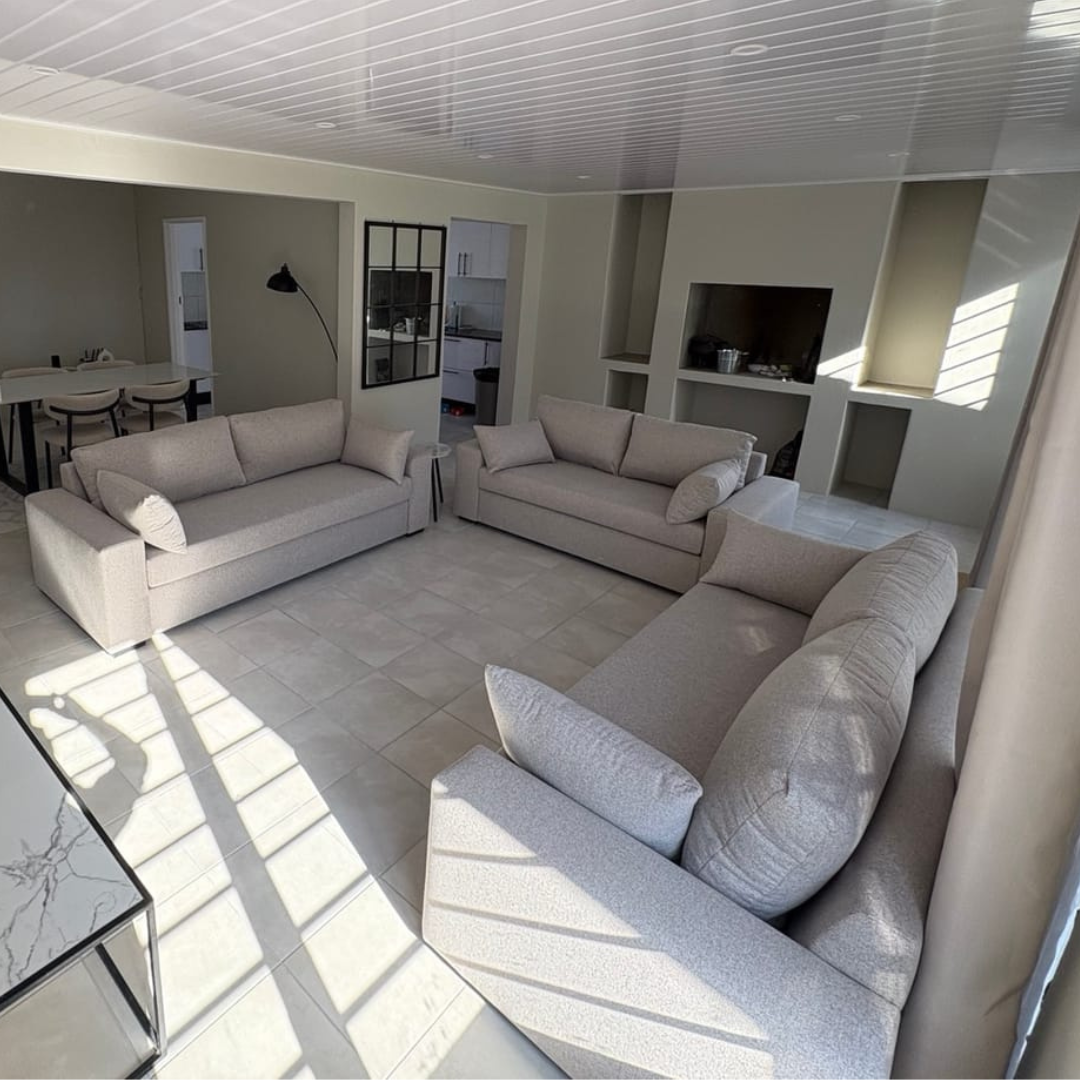
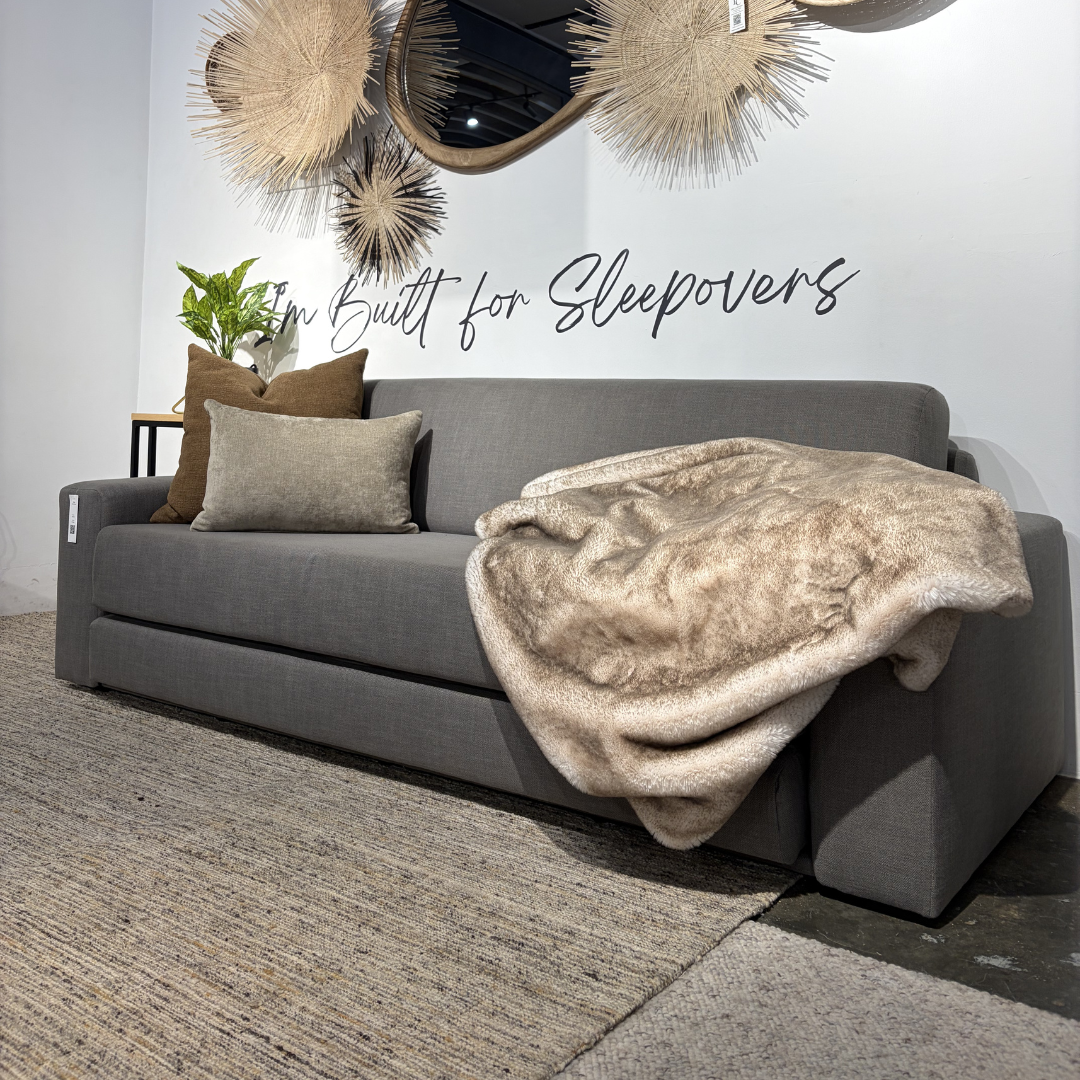
Quick answer: A sectional works best for open-plan living rooms, families, or anyone who wants maximum lounging space and a defined lounge "zone." A standard sofa ( 2-seater, 3-seater or loveseat) works best for smaller rooms, apartments, multi-purpose spaces, or homes that need flexible, easy-to-rearrange furniture. The right choice comes down to your room size, household size and how you actually use the space day to day.
Choosing between a sectional and a sofa is one of the most common, and most confusing, decisions in furnishing a living room. They both do the same basic job (give you somewhere comfortable to sit), but they behave very differently in a room. Here's how to decide which layout is right for your home.
What Is the Difference Between a Sectional and a Sofa?
A sofa is a single, self-contained seating unit, usually a 2-seater, 3-seater or loveseat with two arms and one straight back. It's designed to sit against a wall or float in a room as one clean shape.
A sectional (also called an L-shape, corner sofa, or modular sofa) is made up of multiple sections joined together, usually including a chaise or longer "return" piece. This creates an L-shaped or U-shaped seating area that wraps around a corner of the room.
The core difference is footprint and flexibility: a sofa is a fixed, single-line shape, while a sectional is a larger, corner-hugging shape that can often be reconfigured (left-hand or right-hand orientation, with optional extensions).
Sectional vs Sofa: Quick Comparison
|
Sectional / L-Shape |
Standard Sofa |
|
|
Best for |
Open-plan rooms, families, entertainers |
Apartments, smaller rooms, multi-use spaces |
|
Seating capacity |
High: comfortably seats 4–6+ |
Moderate: typically seats 2–3 |
|
Floor space needed |
Larger footprint, needs a corner |
Compact, fits against a single wall |
|
Flexibility to rearrange |
Lower: designed for one configuration |
Higher: easy to move or re-angle |
|
Lounging comfort |
Excellent (chaise for stretching out) |
Good, but more upright/seated |
|
Style statement |
Becomes the anchor of the room |
Pairs well with chairs, benches, other pieces |
|
Typical households |
Families, pet owners, movie-night households |
Couples, singles, smaller households, renters |
When Should You Choose a Sectional?
A sectional is generally the better layout if:
-
You have an open-plan or larger living room. Sectionals are built to fill space and define a lounge area without needing extra furniture around them.
-
You entertain often or have a bigger household. With 4–6+ seats built in, a sectional means fewer additional chairs are needed.
-
You want a dedicated spot for lounging, not just sitting. The chaise or corner section is ideal for stretching out during movie nights, naps, or lazy Sunday mornings.
-
You have kids or pets. A sectional often becomes the default "everyone pile onto the couch" spot, so continuous seating (rather than gaps between separate chairs) makes practical sense.
Explore L-Shape Sofas and Sectionals to see how these layouts work in real rooms. Two good starting points:
-
The Zola L-Shape is built for households that want options, pair the daybed with a small, medium or large extension to get the exact fit for your corner, with a supportive pocket-spring-and-foam seat (a 3 out of 5 on our firmness scale) and the signature pinch-seam detail running through the seat, arms and backrest.
-
The Lira L-Shape suits a softer, low-slung mid-century look, with continuous seat cushions made for afternoon naps and loose arm cushions you can rearrange for extra comfort. It's available in left-hand or right-hand orientation, so it can be configured to suit either side of your room.
When Should You Choose a Sofa?
A standard sofa is generally the better layout if:
-
You're working with a smaller room or apartment. A 2-seater or 3-seater takes up far less floor space than a sectional and won't overwhelm the room.
-
You want flexibility. Sofas are easy to reposition if you move, redecorate, or want to change your layout down the line, a sectional is far more committed to one configuration.
-
You want to mix and match seating. A sofa pairs naturally with an armchair, ottoman or bench, letting you build a more layered, adaptable living room over time.
-
You're furnishing a secondary space. Studies, guest rooms, and TV rooms often work better with a single sofa rather than a large sectional.
Browse 3-Seaters or Loveseats if a self-contained, flexible layout suits your space better than a corner unit. The Misha Collection, designed with Johannesburg-based creative Misha Levin, is a strong example of this: a soaring high back and deep double-seat that reads as a single considered shape, with washable FibreGuard slipcovers in three colourways, so it delivers a statement piece without the footprint of a sectional.
What About Modular Sofas?
If you like the idea of a sectional's seating capacity but want more flexibility, a modular sofa is worth considering. Modular pieces let you rearrange, add to, or split up your seating as your space or needs change, a useful middle ground between a fixed sectional and a single sofa. Have a look at Modulars to see how this works.
Does Room Size Really Decide It?
Room size is the biggest factor, but not the only one. Before deciding, it helps to measure your space and think through:
-
How many people usually sit down at once, daily, not just when guests are over.
-
How you actually use the space, TV and movie nights favour a chaise-style sectional; a reading nook or occasional-use room favours a compact sofa.
-
Whether you want a "showpiece" or a "team player." A sectional tends to anchor and define a room. A sofa is easier to style around and swap out.
-
Your walking paths. Leave at least 90cm of clear walkway around any seating so the room still feels open, not boxed in.
Can You Have Both a Sectional and a Sofa?
Yes, many larger living rooms use a sectional as the main seating area and add a separate sofa, loveseat or occasional chairs to create additional seating for guests without crowding the main lounge zone. This works particularly well in open-plan homes where the lounge flows into a second seating nook.
See Both Layouts in Person at a Zorora Showroom
Photos and floor plans only tell you so much, sitting in a sectional versus a sofa is the fastest way to know which one actually suits how you sit, lounge and entertain. You can visit a Zorora showroom in:
Gauteng
Western Cape
Our team can walk you through configurations, extension options, and fabric choices on the actual pieces, so you're not guessing dimensions from a screen. Prefer to shop from home first? Order up to 4 free fabric swatches before you visit, so you can already see how your shortlisted colours look in your space.
Final Verdict: Sectional or Sofa?
-
Choose a sectional if you have the floor space, a bigger household, and want one dedicated, sink-in lounging zone.
-
Choose a sofa if you have a smaller room, want flexibility, or prefer to build your living room with multiple, moveable pieces.
Either way, since Zorora sofas are made-to-order, you're not limited to guessing from a showroom floor plan, every sofa and sectional can be tailored in size, configuration, and fabric to fit your exact space. All ranges come with a 10-year frame warranty and 2-year stitching guarantee, and you can order up to 4 free fabric swatches before committing, so you can see and feel your options at home first.
Frequently Asked Questions
Is a sectional more expensive than a sofa?
Generally, yes, because a sectional includes more seating and fabric, it typically costs more than a single sofa of a comparable range. However, made-to-order pricing varies by fabric, size and configuration, so it's worth comparing specific models rather than assuming by category alone.
Can a sectional fit in a small living room?
It can, but it needs careful measuring. Compact or apartment-sized L-shapes exist, but in a genuinely small room, a well-proportioned 2-seater or 3-seater sofa often makes better use of the space and keeps walkways clear.
Which is better for small apartments, a sofa or a sectional?
A standard sofa is usually the better fit for small apartments, since it has a smaller footprint and is easier to move if you relocate. A compact modular piece can also work if you want extra seating without committing to a full corner sectional.
Do sectionals work in open-plan homes?
Yes, sectionals are particularly well-suited to open-plan homes because they help define the lounge area without needing walls, and their larger seating capacity suits the multi-use nature of open-plan living.
What's the difference between a sectional and an L-shape sofa?
They're essentially the same category. "Sectional" is the broader term for multi-piece seating, while "L-shape" describes the specific corner configuration most sectionals use in South Africa. Some sectionals extend further into U-shapes or add a daybed piece.
Zorora - Furniture made for living.